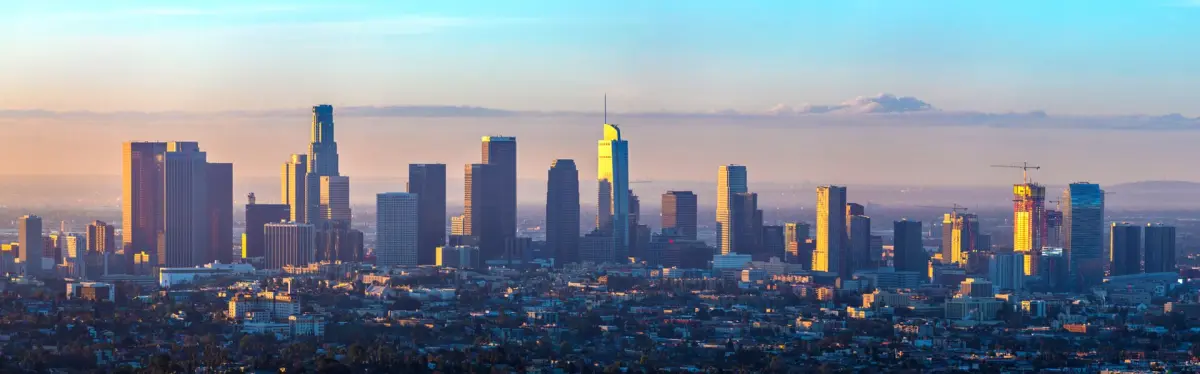
Golden hour is the stretch after sunrise and before sunset when the sun sits low enough that its light comes in at a slant and turns orange. At this latitude the window is short. Néstor Almendros, writing about magic hour in A Man with a Camera, called it an optimistic euphemism on the grounds that the usable light lasts about twenty minutes.
- Latitude
- About 34 degrees north, which is what sets the length of the window.
- Golden hour
- Roughly 30 to 50 minutes here, at each end of the day, rather than the hours available further north.
- Blue hour
- The deep end of twilight, with the sun about 4 to 8 degrees below the horizon. It begins partway through civil twilight and runs past the end of it.
- Earliest and latest sunset
- About 4:44 p.m. in the first week of December and about 8:09 p.m. at the end of June.
- Mount Baldy
- 10,064 feet, and legible from the flats with snow on it the day after a storm clears.
Why the basin gets a good one
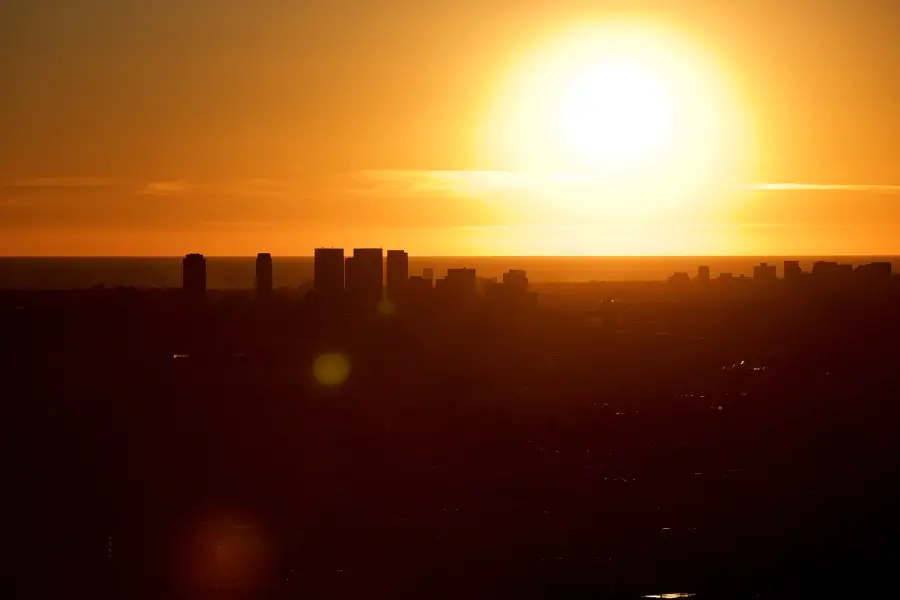
Two things about this coast help. It opens to the west and ends in water, so the last of the sun arrives across a horizon with nothing standing on it. The color comes out of the air itself. Sunlight this low takes a long slant path through the atmosphere, and the air molecules along that path scatter the blue away and leave the red behind. Nothing else has to be up there for that to work, and anything that is up there makes it worse. A heavy particulate load gives a grey, washed-out sunset, so vivid color usually says the air was relatively clean that day. Smog does not improve the light.
What it does to the city
By then the sun is coming in almost horizontally, so the city sorts itself into two halves at once. Everything facing west goes orange and everything facing east drops into flat blue shade. Stucco takes it best, and a plain apartment building on a plain street, the kind nobody photographs, will be the color of a peach for about ten minutes before it goes back to being beige. Glass on the downtown towers catches the same light and throws it back. Palm trunks go black while the fronds above them keep the light.
Westbound on the 10 or on Wilshire the sun sits exactly in the windshield and the visor does not reach that low. A sun that low and in line with a signal head can make the signal colors unreadable, which is why signals get retroreflective backplates, and traffic slows where it happens. Then it is over, and the warmth on your face goes with it.
Through the year
The clock time is the least stable part of this. Between the earliest evening in December and the latest in June the difference is more than three hours, and that is the figure worth carrying. The consequence is winter. From late autumn the last light lands in the middle of the evening commute, on the same west-running boulevards, with the whole city driving into it.
The NOAA solar calculator gives sunrise and sunset for any date and for the spot you are standing in.
Blue hour
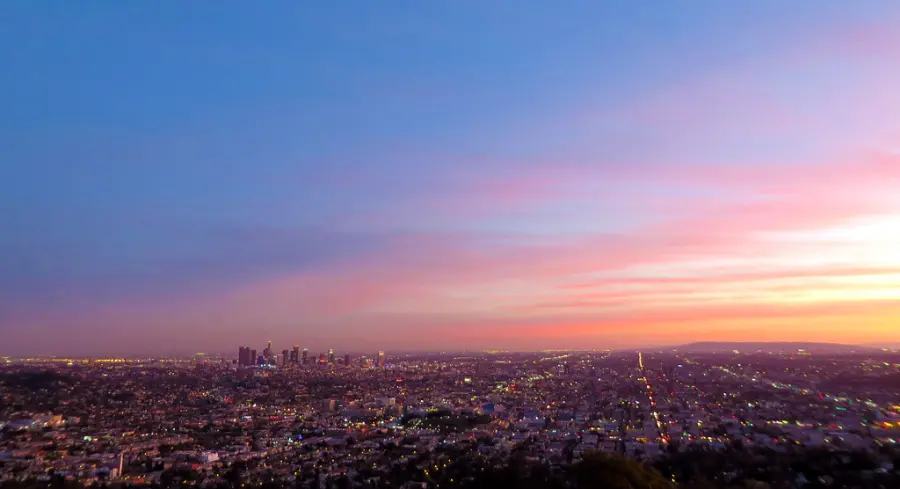
Blue hour is the deep end of twilight, when the sky is still bright and the ground has already gone dark. It begins partway through civil twilight and runs past the end of it. The streetlights come up during that window, unevenly across the basin, and headlights come on car by car instead of all at once. The mountains lose their depth and go to a single black cutout. Office floors are lit and still readable against a blue sky. Near the water the onshore breeze picks up and the damp marine air cuts through bare arms.
Where to stand
Anything facing west with a clear horizon works, which on this coast means the beaches, where the parking lots empty while the sand is still full. Griffith Park is the other obvious one. The Observatory lawn is on the north side, in front of the main doors, with the Astronomers Monument standing on it. The city view is on the other side of the building, off the south front and the Promenade Walkway. Downtown sits to the southeast from there, off to the left of the Vermont Canyon line and not straight down it. The Hollywood Sign view is on the west side. Parking on Observatory Road is the real event, with cars idling in a single lane for a space hours before dark. Parrots cross overhead in loud flocks on their way to the evening roost.
The Baldwin Hills Scenic Overlook sits at the Culver City end of the Baldwin Hills, above Jefferson Boulevard. From the deck the view runs from the ocean in the west around to downtown and the San Gabriels in the northeast, with planes stacking into LAX behind you to the south. The top is paved, with a parking lot and a visitor center, reached by Hetzler Road or by the stairs up the face. Restored native scrub and sagebrush cover the hillside under it. Mulholland runs the top of the Santa Monica Mountains with the same order of view, and that road has a page to itself.
When it does not happen
The marine layer takes the coast out often enough to plan around. On those evenings the beach sits under a flat grey ceiling while the light is still working inland, and in summer the deck frequently comes back in during blue hour itself. How that works is on its own page.
The morning after a storm
Rain here falls between November and April. The morning after a storm clears is the other light worth planning for, because the offshore flow behind it scours the basin out and leaves nothing in the air to soften the distance. Shadows go hard. Snow sits on the San Gabriels and Mount Baldy reads from the flats. Catalina shows up from the coast.
The photographs on this page
Three photographs on this page were made by other people and shared under Creative Commons terms. The one at the top is downtown seen from Griffith Observatory, with the towers taking the light on one side and staying grey on the other. The photographer gives it as sunset, though the Commons file it comes from is titled sunrise. There are tower cranes standing on the right of it.
The rest of this section, including the roads once the light has gone, is in Los Angeles after dark. Nothing has been released yet. When that changes, one page will carry every place to hear it.