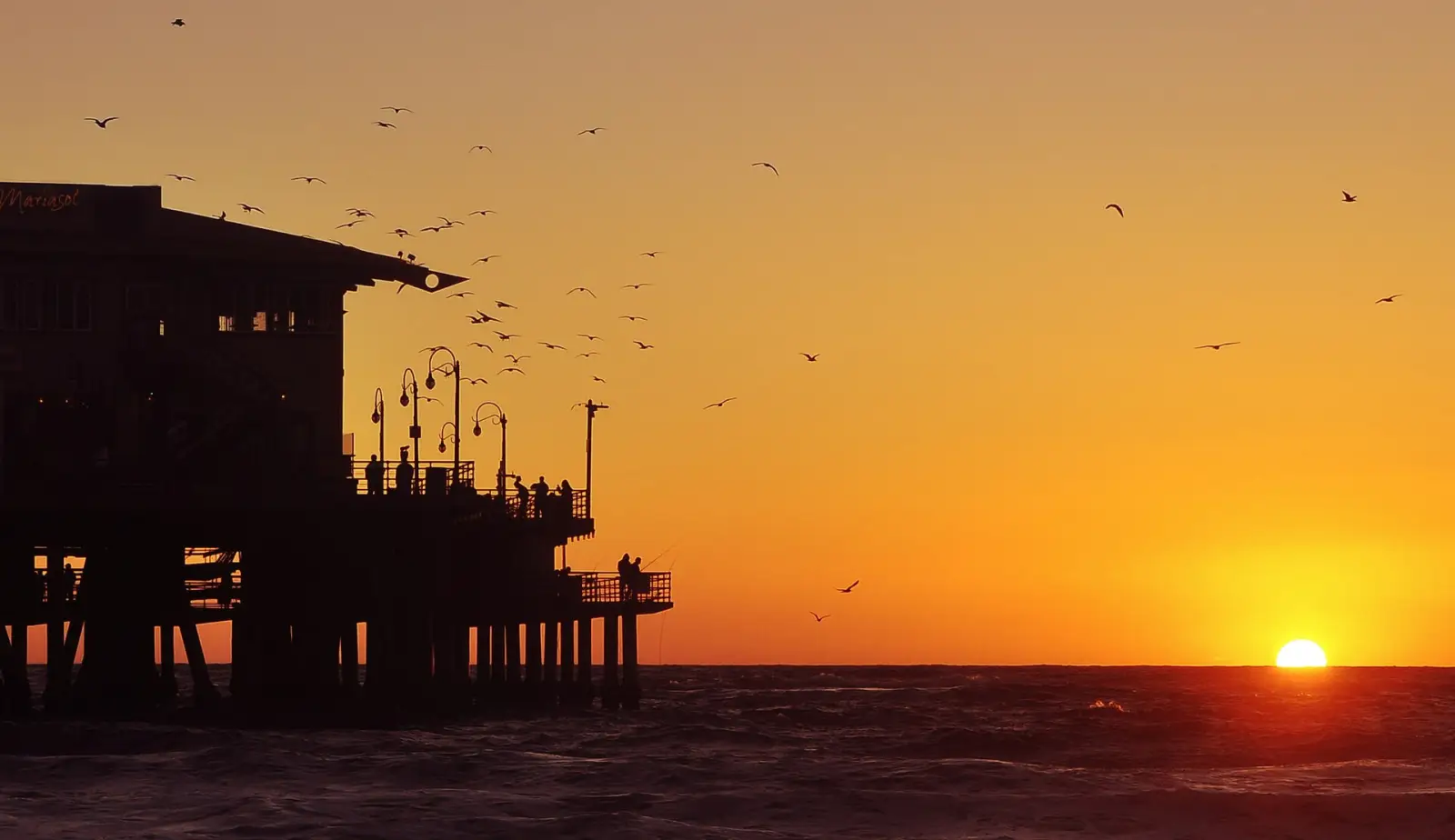
The marine layer is a shallow body of cool, damp air that sits over the coast with warmer air resting on top of it. That warmer air is the inversion, and it works as a lid. The cloud that forms in the cool air underneath is stratus. Its base sits at the height where the air condenses and its top is pressed flat by the lid, so what comes in over the coast is a sheet, level underneath and level on top. It settles at the height the lid allows and stays there.
- Peak season
- Late spring and early summer, which is where May Gray and June Gloom get their names.
- Same hour, two places
- 62 degrees and grey at the coast while the San Fernando Valley is 90 degrees and clear.
- Furthest inland
- The San Fernando and San Gabriel Valleys when the layer is deep, sometimes as far as Santa Clarita.
- Ozone season
- Roughly May through September, when the sunlight has the most to work with.
- Mount Wilson Observatory
- 5,715 feet, on the front range above Pasadena.
- Layer depth
- Reported in feet in the aviation section of the forecast discussion linked below.
Why it forms here
The California Current runs south along this coast and keeps the water cold well into summer. Air sitting on cold water cools from below. Above it the Pacific high presses down and warms as it sinks, which leaves cool air underneath a warm cap with the inversion between them. That is a stable arrangement and a reluctant one to mix. Onshore flow pushes the slab in over the beach cities overnight. The gradient that pulls air in off the water while the land is hot is still working after dark. With the sun down, nothing burns the cloud back.
May Gray and June Gloom
May Gray and June Gloom are the local names for the stretch when this happens on most days in a row. They are not a joke about disappointing weather. Late spring and early summer are when the sea is coldest relative to the land, which is the setup the pattern needs, so book a week at the beach in June and you can get grey from breakfast until the middle of the afternoon on every day of it. The pattern is seasonal and the names are accurate.
The daily cycle
The deck is thickest in the morning. Sunlight gets through it and warms the ground underneath, and that warmth mixes back up into the cloud and evaporates it. Land heats far faster than water does, so the breaking starts inland and works its way out toward the coast. At ten on a June morning you can be standing under it at the beach while the valleys are already in full sun.
In the evening it comes back the way it left, out of the west, and it can put a coastal street back under cover in under an hour. Nothing about that requires a storm.
Where it stops
The coastal plain holds most of it. When the layer is deep it fills the basin and pushes through the passes into the San Fernando and San Gabriel Valleys. On the deepest mornings it reaches Santa Clarita. When the pressure is high the layer is squashed shallow and stays pinned near the water, and that is the morning when the coast is grey and cold while the San Fernando Valley is sunny and hot in the same hour. Drive inland for twenty minutes on one of those days and you come out from under the grey into full heat. The forecast for the coast is not the forecast for the Valley.
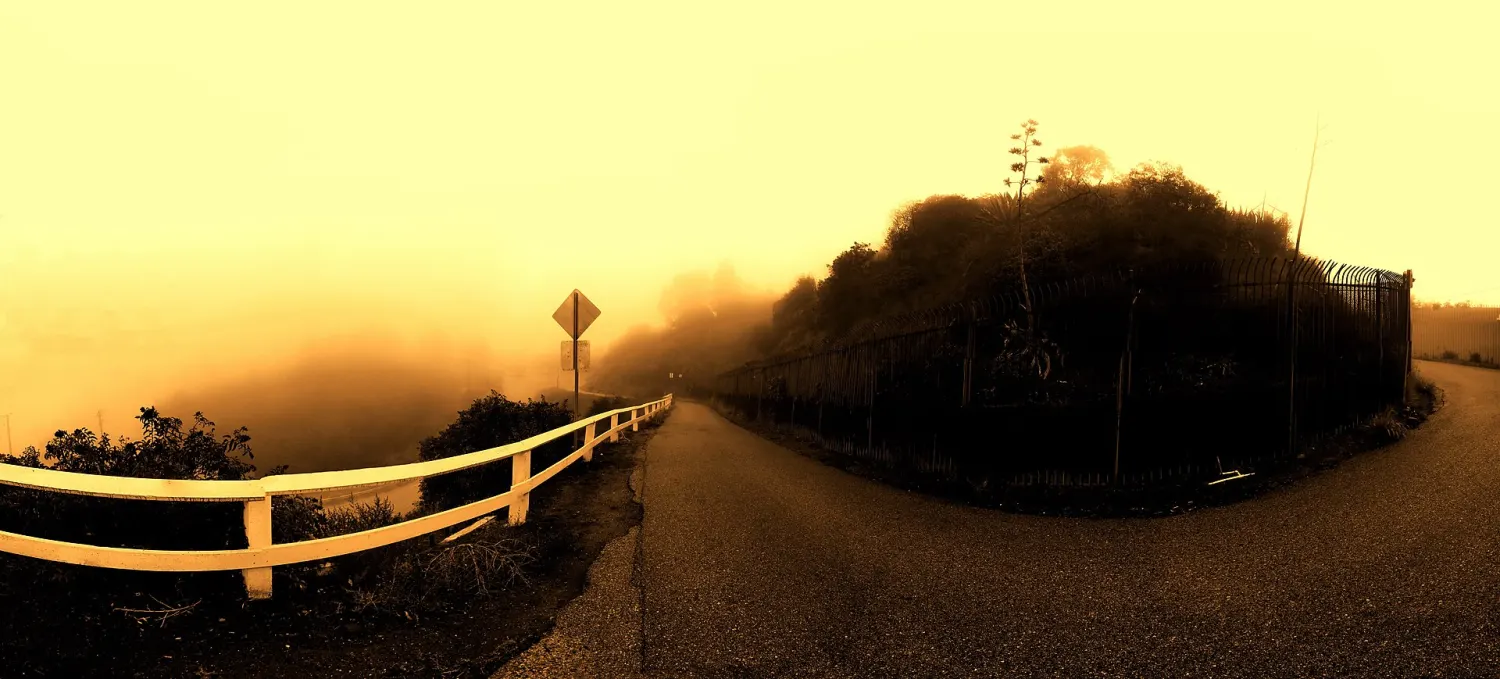
The lid
Mountains ring the basin on three sides and the inversion caps it from above, so what the city puts into the air has nowhere to go. Sunlight acting on vehicle exhaust makes ozone. The smog season here is the warm half of the year rather than the cold one. Look north toward the San Gabriels on a summer afternoon and you can see a brown-grey band lying under an otherwise blue sky.
The air is far cleaner than it was in the 1970s and it is still routinely among the worst in the country for ozone. The lid holds the city's own light in as well, so the sky over the basin at night is never black, only a low white glow with the stars burned out of it. From an aircraft on descent the top of the layer is a flat line.
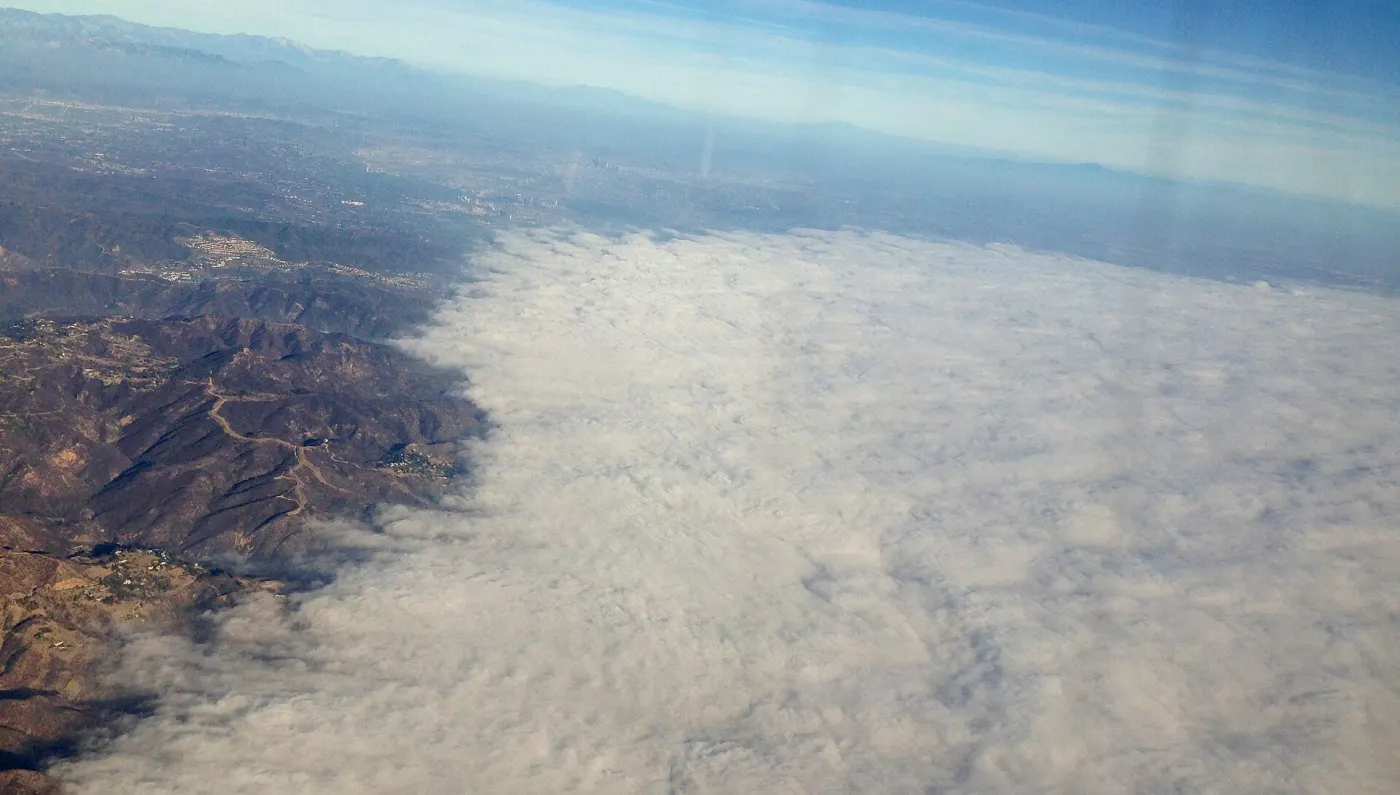
The mountain above it
Mount Wilson Observatory sits on the front range above Pasadena, on mountains that come up off the valley floor with almost no foothills in the way. George Ellery Hale chose the site after testing the seeing there. The same inversion that traps the haze over the basin leaves the air above the mountain unusually steady, which is how an exceptional observatory ended up directly over the light dome of a whole city. The site is still in use.
The marine layer sometimes lies below the summit at night, with the ridgelines standing out of it and the basin underneath it out of sight. On those nights you are standing above the cloud instead of under it. The antenna farm on the summit is lit at night and the lights are visible from across the basin.
A morning under it
Under a June ceiling there is no sunrise. The sky goes from black to a flat pale grey with no color in it, and it happens slowly enough that you notice it has already happened rather than watch it happen. Put your hand flat on the roof of a car parked outside at dawn and it comes away wet, with no rain having fallen.
Streetlights and lit signs pick up a halo and the whole street looks lit from inside a lampshade. Sound carries differently under a low ceiling, so a freeway a mile away is louder and closer than it usually is.
Runners and dog walkers are out on the river path while it is still grey. The first leaf blower starts around seven and another answers from further down the block.
How to check it
The National Weather Service office for Los Angeles and Oxnard publishes a forecast discussion in plain text several times a day. The aviation section gives the depth of the marine layer in feet, measured at the airport, and a shallow layer burns off sooner than a deep one. Read the discussion rather than a summary of it. If you are deciding about a morning at the coast, the depth figure is the one to look at.
When it clears
Some days the layer breaks up in time for the evening and some days it does not. On the days it does, the last good light runs shorter than the hour its name claims, and golden hour is about why. The roads under the deck after midnight are on night drives. The ridge that separates the grey coast from the hot Valley carries Mulholland Drive along the top of it, and Mulholland at night is about driving it. All three are part of Los Angeles after dark.
Nothing has been released yet. When there is something, every place to hear it will be on one page.