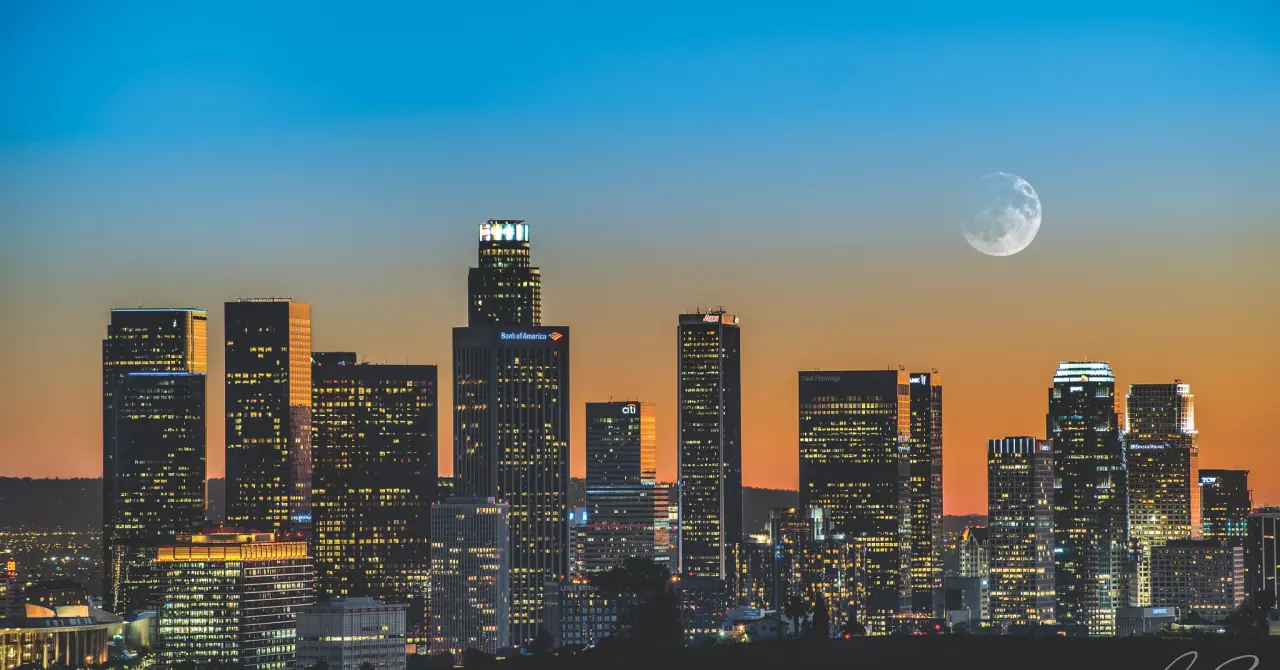
Mulholland Drive runs along the crest of the Santa Monica Mountains and carries the name of William Mulholland, the engineer who brought the city its water. The ridge is the whole reason the road is there. The city grid lies on one side of it and the San Fernando Valley on the other, and the pavement holds the line between them for most of its length.
- Inside the city
- About 24 miles of Mulholland Drive within the City of Los Angeles.
- The whole corridor
- About 55 miles, counting the unpaved Dirt Mulholland and Mulholland Highway out to the coast.
- Who runs the overlooks
- The Mountains Recreation and Conservation Authority, which maintains seven scenic overlooks along the Mulholland Scenic Parkway.
- Default park hours
- Its park ordinance closes parkland from thirty minutes after sunset to thirty minutes before sunrise, unless different hours are posted on site.
- Jerome C. Daniel Overlook
- 7036 Mulholland Drive, above the Hollywood Bowl. Posted closing 6 p.m., the earliest on the road. Reopened in June 2026 after a year of reconstruction. Access can be restricted during Hollywood Bowl events.
- Universal City Overlook
- 7701 Mulholland Drive, Studio City. Posted closing 9 p.m.
- Nancy Hoover Pohl Overlook
- 8401 Mulholland Drive. Posted closing 9 p.m.
- Barbara A. Fine Overlook at the Summit
- 11801 Mulholland Drive. Posted closing 9 p.m.
- Posted limit
- 35 mph on stretches of it, with speed humps on several blocks.
What it does at night
The road holds the ridgeline instead of cutting through it, so the view changes sides every few curves. Heading west, the San Fernando Valley opens on your right, a flat grid burning out to the far hills. A curve takes it back and the basin arrives on your left, lying lower than the Valley floor does. The road spends the rest of the night making you choose which set of lights you would rather be looking at, then drops into the trees and gives you neither.
Most of it is two lanes. Long runs have no streetlights, so there is nothing on the pavement but the raised markers ticking back the low beams and whatever comes the other way. It is cold up there at night. The road is narrow and blind-cornered, and headlights arrive around a curve before the car does.
The overlooks
The overlooks are free, and the Mountains Recreation and Conservation Authority runs them. Its park ordinance closes parkland from thirty minutes after sunset until the same margin before sunrise, unless different hours are posted on site. Where an overlook posts its own hours, the posted hours are the ones that govern, and along this road they are not the same from one entrance to the next.
So which gate you meet depends on which overlook you pick. The Jerome C. Daniel Overlook, above the Hollywood Bowl, posts the earliest closing on the road. In summer that shuts it while there is still light in the sky, and in December the gate outlasts the sunset by more than an hour. Universal City, Nancy Hoover Pohl and Barbara A. Fine post the latest closing, late enough that they stay open past full dark on every night of the year.
The Bowl adds a condition of its own. Access to the Jerome C. Daniel Overlook can be restricted when there is a show on below it, so the posted hour is the outside limit and not a promise. From the Universal City Overlook the Valley reads as a flat lit plane running to the San Gabriels, with the studio backlot and the 101 in the near ground.
Not all of them are gated. Some are open pull-outs with nothing across the entrance, and elsewhere the barrier is a chain across the driveway rather than a gate. The park ordinance still applies where there is nothing to lock.
Where people park
The lots are the constraint, not the hours. They are small, the one outside the Jerome C. Daniel Overlook most of all, and on a clear evening they fill. What does not fit ends up on the dirt shoulder outside, half on the pavement with the hazards on, which is why Council District 4 has been working with the conservation authority and the fire department on that stretch of Mulholland.
That shoulder is not a parking lot. It is loose dirt beside an unlit two-lane road, and a car left on it can be cited.
Dirt Mulholland
Not all of the corridor is paved. Dirt Mulholland is the unpaved stretch, closed to cars and open on foot and by bike, and it is a daylight route rather than a night one because nothing along it is lit. Deer are on those sections.
San Vicente Mountain Park sits on that stretch west of the 405, on an old Nike radar site, and the tower left standing there is high enough to show both halves of the city from one platform. The conservation authority credits it with views of the Santa Monica Mountains, the San Fernando Valley and the Los Angeles Basin. Every built overlook on the paved road faces one way or the other, so at a gate you get one half at a time and have to turn around for the rest.
When not to go
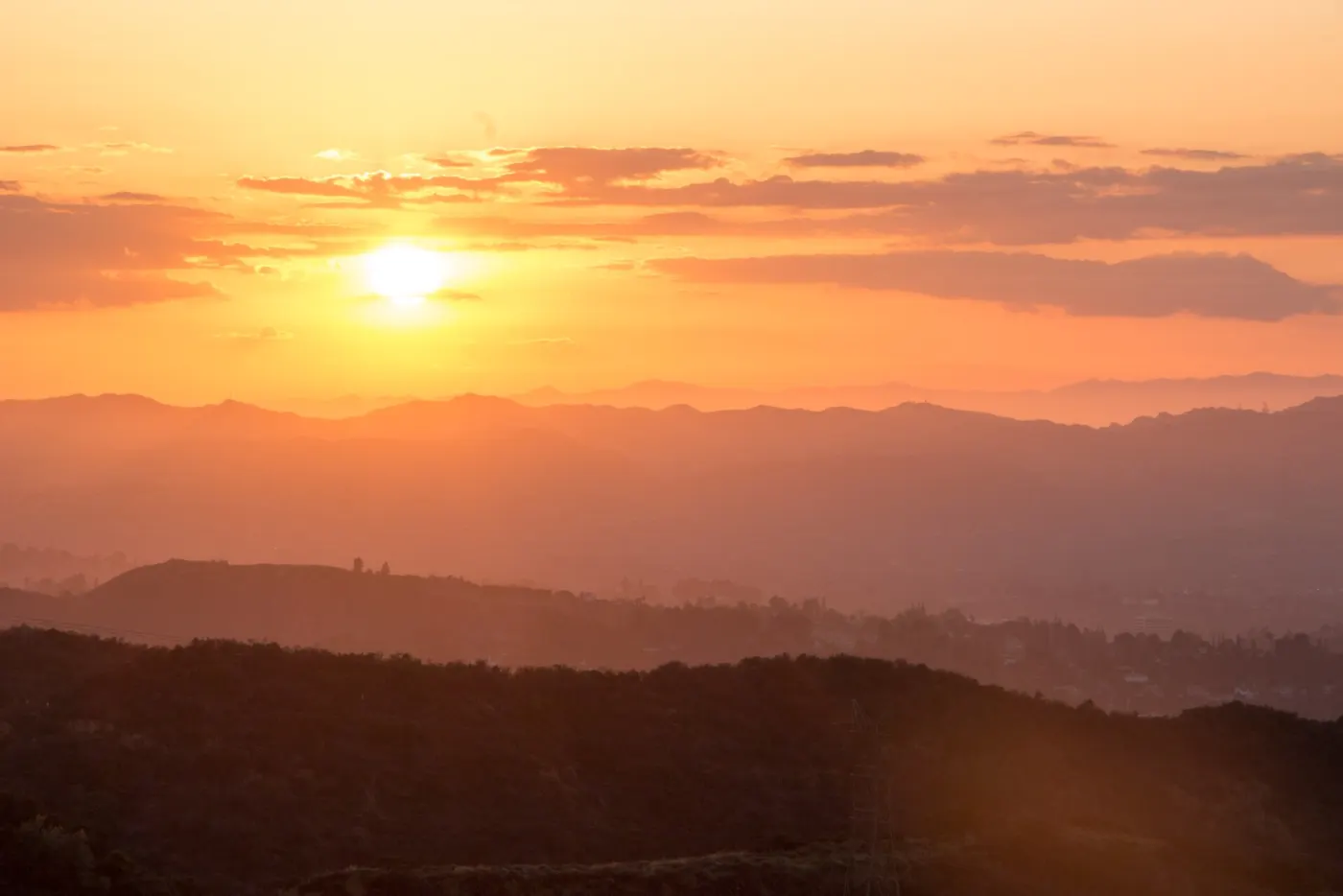
Coyote eyes show up at the edge of the brush before the animal does. Fog sits on the ridge on some nights, and the road is inside it rather than under it. Red flag days bring fire road closures.
Long stretches of Mulholland are residential. People live on the corners that are good to take fast, and they have been complaining about the racing on them for decades, which is why the city has laid about a dozen speed humps along the road, at the Dona Pegita turns and near the Universal City Overlook. The transportation department gives racing and unsafe driving as the reason for them, not noise.
A speed safety camera is planned for the stretch between Corda Drive and Calvena Drive, as part of the city pilot. It is not issuing tickets yet. A car working the curves at 2 a.m. up there is a nuisance.
Getting there
The east end of the paved road is at Cahuenga Boulevard, in Cahuenga Pass beside the 101 and just above the Hollywood Bowl. Further west, Laurel Canyon Boulevard and Coldwater Canyon each cross the ridge, so either one will bring you up from the basin or down into the Valley depending on which way you turn at the top. Both of them have houses on them the whole way up.
Nearby
The hour before the light goes is shorter than the name for it suggests. That has a page of its own. The driving that starts once the ridge is behind you is on another. Both sit inside Los Angeles after dark with the rest of this section. Platform links go on the listening page.